
Labour sweeps to power on the weakest massive mandate in decades – while 40% of the electorate didn’t bother to vote
So the dust has finally settled on one of the dreariest, dullest and most depressing General Election campaigns of our times.
With a popular vote which is lower than that gained by Labour under Jeremy Corbyn in 2017 and 2019 and even lower than under Neil Kinnock (better known these days as Baron Kinnock of Bedwellty) in 1992, the Labour party, led by the block of wood masquerading as a man of the people (remember, his dad was a toolmaker/factory owner) that is Sir Keir Starmer has fallen arse-backwards into a majority of gigantic proportions but derived from an electoral mandate so weak that they themselves could be swept from power in a similarly dramatic fashion within five years.
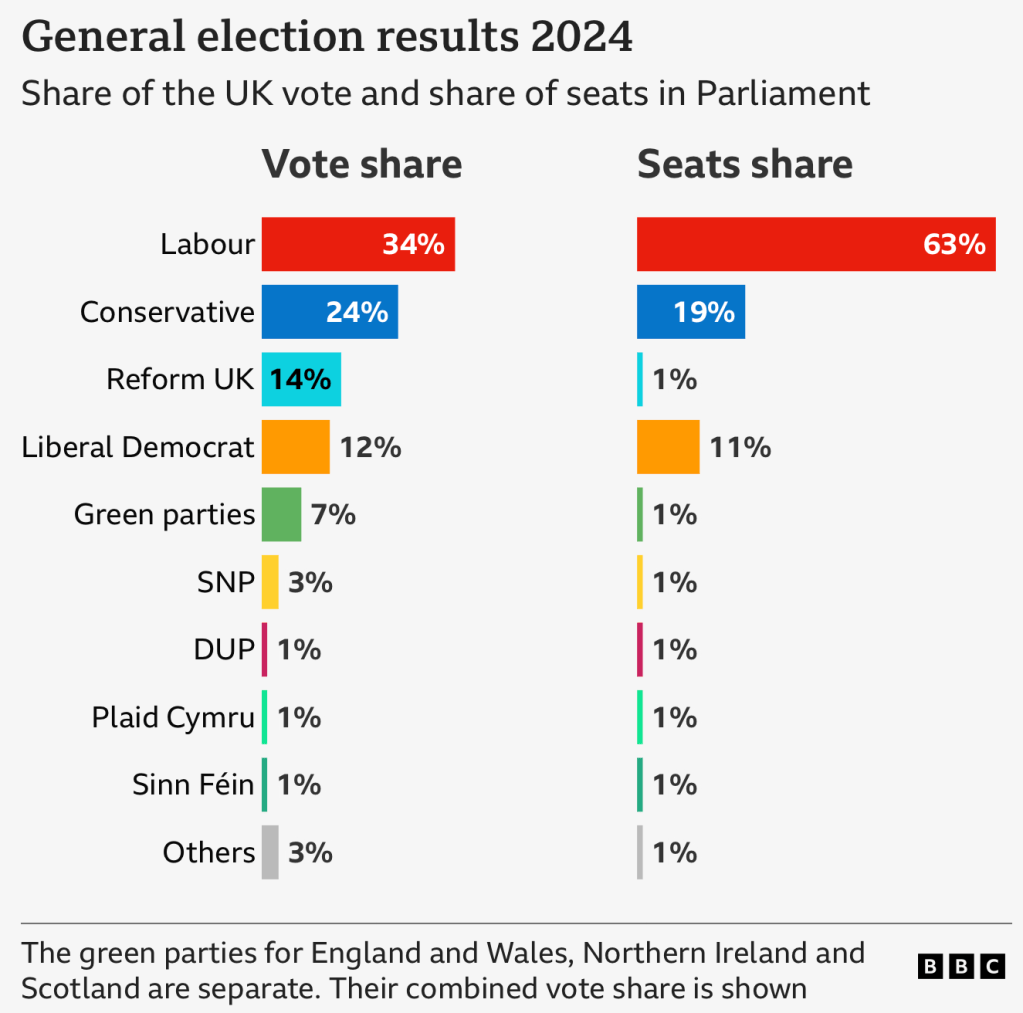
The figures are stark: The Labour party, with just 34% of the share of the vote, gained 63% of the seats in parliament as the support for the incumbent Conservatives collapsed. Labour saw their popular vote drop to below 10m, which totally belies the enormous parliamentary mandate that they have managed to gain and would bring into question whether any of the policies, particularly those of a more cultural nature, that Labour will push through parliament have anything like the popular support that they or their media supporters will claim that they have.
There will be some who will hark back to the elevation of Labour to Government in 1997 and make direct comparisons between the Labour of then and the Labour of now. But the only comparable facets of that win in 1997 and now is the number of seats won – Labour won 418 seats in 1997 and 411 now. Labour won almost 4 million more votes in 1997 than they did on 4th July and won in 1997 by seizing votes directly from the Tories, whereas in this election seats were seized from the Tories by their votes shifting not to Labour, but to Reform UK. Meanwhile in Scotland, Labour have directly benefitted from the utter shitshow that the Scottish National Party has become by snatching dozens of seats that were held by the SNP since 2015, leaving the Nationalists with only nine seats.
Similarly stark is the huge disparity in turnouts in 1997 and 2024. In 1997, there was a turnout of 71% which, while down on the previous General Election, compares favourably to the 2024 turnout of just 59% which, while almost 20% higher than the turnout that I was expecting, is the lowest since 2001 and means that, for the first time since the Second World War, people who did not bother to vote were in greater proportion than any party, including the eventual winner of the election.
The Collapse of the Conservative Vote
I tweeted a few days ago that, if I was to give the Conservative and Unionist Party one piece of free advice for restoring their electoral fortunes, then they might want to give actual conservatism a try. Whatever your views on conservatism, and I am not a fan myself, the fact is that the Conservatives haven’t been conservative for over forty years. Yes, they have been free-market loyalists and have waged an all-out war on the working class in those forty years, but they have largely marked themselves out as liberals and the great bulk of the parliamentary party have been as willing to implement similarly liberal policies as their opponents in the Labour party. There is nothing to distinguish the parliamentary Conservatives from Labour in 2024 – they are from very similar backgrounds, have similar upbringings, attended similar universities, similarly avoided actual work in order to become interns for similar MPs and would be equally comfortable whichever side of the house and whichever party they ended up in.
One could argue that the Conservative’s fate was sealed in the last eighteen months, firstly with the ousting of Boris Johnson, who had delivered an 80-seat majority with a promise of delivering the Brexit that had been voted for in 2016 but was also ably assisted by a Labour party whose internal machine was as determined to see Johnson win as it was see their own leader lose. Johnson proved himself to be an able Prime Minister in some ways, but severely lacking in others: He often landed heavy blows on Jeremy Corbyn in Parliament, but showed himself to be lacking in conviction when he was pushed from pillar to post during the covid crisis, allowing himself to be corralled into implementing lockdowns which didn’t work, mask mandates that didn’t work and rolling out an immunisation programme that didn’t work, all based on deeply-flawed and now discredited computer-based modelling.
Johnson’s replacement, Liz Truss, lasted just fifty days in office before she was made the victim of a coup carried out by the ruling bureaucracy, including the Bank of England, after her then Chancellor of the Exchequer Kwazi Kwarteng unveiled a mini-budget which included tax cuts buttressed with increased public borrowing in the hope of stimulating growth in an economy which had been flatlining since 2008 and had been depressed further by the Government shutting down huge sections of the economy in its ham-fisted reaction to covid. The markets panicked – the British Pound fell to the lowest level against the US dollar in history and the Chancellor resigned, swiftly followed by the Prime Minister herself. All the while, the modern British left’s best and brightest took to social media to gloat at the demise of Britain’s third woman Prime Minister, while conveniently overlooking that not one protagonist in the plot to overthrow her had ever faced any form of democratic scrutiny themselves.
Which brings us to Rishi Sunak, who inherited the post of Prime Minister in 2022 and held the post until the General Election on July 4th. His term of office has been marked by persistent and rampant inflation in the aftermath of covid, including huge hikes in food and fuel prices, as well as continuing turmoil in Europe as the Russian military operation in Ukraine edges closer to completion in favour of the Russians. This was accompanied by the Government’s continued and steadfast support for the genocide taking place in Gaza (which Labour will also support, arguably in even more bold terms), while Boris Johnson’s reputation, already sullied by playing the role of messenger boy to US imperialism as he travelled to Ukraine to tell Volodymyr Zelenskyy that he couldn’t have the peace deal he thought he’d negotiated, was in tatters after he was found to have breached the very covid restrictions he’d allowed himself to be bounced into putting in place.
The electorate had grown weary of the Conservatives after fourteen years in power and with nothing to indicate that the state of the nation had improved in any way in that time. However, Labour had made little headway towards winning the trust of voters, despite their proclamations that they had ‘changed’, which in reality meant that it had either expelled or driven out any remaining remnants of the Labour left daft enough to continue to believe that they were still a vehicle for positive change in Britain. Essentially, Labour wouldn’t not be able to defeat the Conservatives in a straight fight unaided. But, as is often the case, where the ruling class requires it, a suitable alternative presents themselves.
The Rise of Reform
The Conservative’s electoral collapse on July 4th is due almost entirely to the rise of Reform. Their manifesto focussed on populist policies: To freeze ‘non-essential’ immigration (which is neatly worded to allow immigration to continue), tax cuts for big business, scrapping Net Zero targets, banning Gender Ideology in schools and giving extra money to the NHS. These policies clearly were popular with voters – their popular vote across Britain gave them 4 million votes, more than the Liberal Democrats, but critically Reform UK came in either second or third place in many of the seats in which they stood. They took enough votes from the Conservatives for them to lose these seats, but not enough votes for Reform to win them themselves, except for the five seats (including Clacton, won by Reform leader Nigel Farage) that they did win.
However, given that the ruling class was determined to sweep away the Conservatives from office and replace them with the disappointing tribute act to the 1997 version of Labour, Reform served its purpose by siphoning support from the Conservatives and helping to guarantee a Labour victory. This explains how in the last six weeks the media has pushed forward both Nigel Farage and the party he leads relentlessly, despite them having during this period no seats in parliament at all. Compare this to the near non-existent media coverage received by the Workers Party of Britain, who had one Member of Parliament in George Galloway, one more than Reform had.
Despite the rantings of the modern left, Reform is not a fascist party and Nigel Farage is a Thatcherite, who would not have been out of place on the Tory backbenches in the 1980s. This is what has made him and his party so popular with the Conservative core vote: With the Conservatives having lost their way, particularity culturally, it was inevitable that a party would present itself to fill the breach and Reform did just that. However, with just five MPs returned (exit polls predicted over twenty), it will be interesting to see if Reform will be able to build on their wins and, as they desire, will replace the Conservatives as the party of British conservatism.
The Curious Case of the LibDems
The Liberal Democrats had an extremely successful General Election, leaping from 8 to 72 seats and reclaiming the stronghold that they formerly enjoyed in the southwest of England. They also took seats from the Tories in home counties like Surrey and Berkshire, where voters had clearly had enough of the Tories but were not sold on Labour as an alternative. I myself had taken no time whatsoever to examine their policies in any depth, but apparently the manifesto included real and positive changes like recognising non-binary gender identities and giving 16-year olds the vote. They also pledged to reach ‘net zero’ by 2045 and conjuring up more doctors, presumably from thin air.
It is my view that it is unlikely that the LibDems restoration to the number of seats that they had enjoyed (and subsequently lost in 2015) was an endorsement of their policies – even with my cursory glance they appear to be wishful thinking or bold policies from a bourgeois party which knows it will not see power. It’s conceivable that these polices were closely aligned to those of the Labour party, partly because they are very closely similar parties in their policies and also because the LibDems considered that they may end up being the makeweight in a possible Liberal-Labour coalition. As it was, the vagaries of the electoral system gave Labour a huge majority without having to work overly hard to get it.
The Welcome Demise of the Scottish National Party
I had stated previously that I believed that Labour winning a majority of the size and scale achieved under Tony Blair’s leadership in 1997 was impossible because there were some 50 seats that would be unobtainable to them – those being the seats in Scotland. However, in making my bold claim I had not anticipated that the Scottish National Party would collapse into woke liberalism in quite the way that it did and would suffer the punishment that it did on July 4th.
The ill-conceived Scottish independence referendum in 2014, which was a natural progression from the similarly ill-conceived policy of devolution for Scotland 1999, gave rise to the enormous growth of the Scottish National Party and their subsequent electoral success in the 2015 General Election. The phrase ‘Red Tories’ may not have been originally coined in Scotland, but that was certainly where it came to prominence as Scottish voters became sick and tired of a Labour party which, to be blunt, had been taking the piss out of them for decades. As far as Labour was concerned, whatever the fortunes of the party in England and Wales, Scotland was a fifty seat given. But Labour’s actions in the 2014 independence referendum and the General Election of 2015 were watershed moments for both Labour and the SNP.
For nine years the Scottish National Party lorded it over Scotland, both in the Scottish Parliament and in the Palaces of Westminster. Whilst it could be argued that there were genuine Scottish nationalists among their number, leaders Nicola Sturgeon and her replacement, Humza Yousaf, have positioned the party to extract concessions from the Westminster Government using the threat of agitating the Scottish electorate towards another independence referendum as leverage. In the main this strategy has worked, but without a genuine movement towards a further referendum the SNP pivoted towards distinguishing themselves and Scotland from Westminster in every and any way it could, which in the end backfired on them badly.
The first serious misstep was the Hate Crime and Public Disorder Act (Scotland) 2021, a piece of pernicious legislation which brought previous pieces of legislation under one bill, but led to criticism amongst free speech advocates, including that people could be in violation of the act simply for sharing an opinion in their own home and that First Minister Humza Yousaf violated the act himself when he made a speech in 2020 which was considered by some to be ‘anti-white’ in nature. The legislation sat unratified for three years whilst the police and other state authorities tried to work out how the laws could be enforced. When it did come into force on 1st April 2024, the police were deluged with complaints of hate crime, many of them vexatious, leading them to make a statement that they should not be charged with enforcing free speech. In the chaos that ensued, for days after the introduction of the law hate crime was the single biggest crime allegedly committed in Scotland. The SNP stood by the bill.
Subsequent to this was the Gender Recognition Reform (Scotland) Bill, which was passed in the Scottish Parliament, with the full support of Scottish Labour, at the end of 2022. The Act was intended to make it easier for an individual to change their legal gender according to the provisions of the Gender Recognition Act 2004, including lowering the minimum age to legally switch gender to 16 and reducing the required period of ‘gender socialisation’ from two years to three months. However, it meant that a Gender Recognition Certificate could be issued in Scotland under their criteria, only for it to be null and void when that person crossed the border into England because the qualification criteria is markedly different: In essence a legally-recognised woman in Scotland could cross the border into England and legally become a man.
The Westminster Government responded and enforced a ‘Section 35 order’ – the power to intervene in cancelling an act passed in the Scottish Parliament if it adversely affects laws in the rest of the UK. The Act was cancelled. The SNP were incredulous. Yet it was the SNP who accepted the provisions included in Section 35 as part of the legislation which gave birth to the Scottish Parliament. The actions of the SNP and the Scottish Parliament in attempting to distinguish themselves from Westminster had backfired badly – even the Scottish electorate agreed that the Westminster Government was correct in shooting down the legislation.
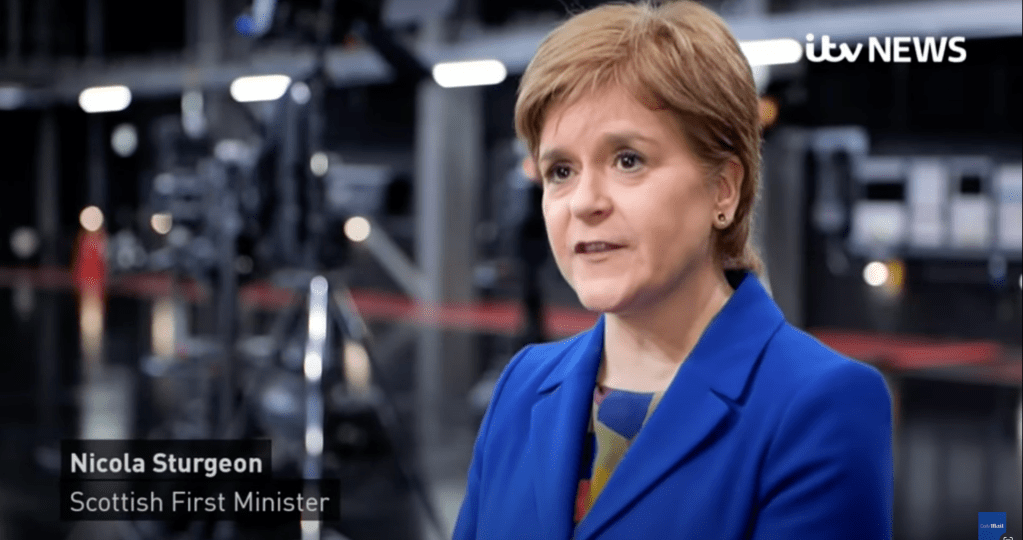
The SNP were not helped by then-leader Nicola Sturgeon’s car crash interview with STV, where she stated clearly that trans women were women, but there were some occasions when these women would be placed in men’s prisons. This interview came after the case of Isla Bryson, a self-identified trans woman who was placed in a woman’s prison after being convicted of two counts of rape. It was this case and the media furore which surrounded it that was used to criticise the Gender Recognition Reform (Scotland) Bill, and Sturgeon’s floundering under what was atypically robust questioning from the STV journalist given the subject matter severely dented public confidence in Sturgeon as a political leader. Sturgeon resigned shortly after.
The demise of the SNP should be welcomed: The petty bourgeois liberal ideology which the SNP represents is long overdue to be consigned to the dustbin of history and it appears on its face that any remaining possibility of there being a referendum on the independence of Scotland at any time in the near future is dead.
The Electoral System
Observers will quite rightly raise an eyebrow when they see the election results and at least attempt to correlate the popular vote count of the Labour party, or the LibDems or Reform with the number of seats that each part gained. Of the three, it is actually the LibDems who have the closest number of seats as a percentage to the percentage of votes gained – 11% of the seats on 12% of the vote. Reform supporters will be scratching their heads wondering how their party could garner 14% of the vote, yet have only 1% of the seats. Britain’s ‘first past the post’ system dates from the Middle Ages and is one of the simplest voting systems there is. At the same time, it is an extremely wasteful and inefficient voting system – to take one example, which was the election in the Braintree constituency in Essex, James Cleverly retained his seat with a total vote of 17,414. But 31,614 registered a vote that wasn’t for Mr Cleverly and those votes essentially go into the bin.
It is why Labour have the biggest majority in Parliament since 1997 on a popular vote of 9,706,125, yet the collective votes for parties which are not Labour votes totals 19,086,772. This has led to many to call yet again for changed to the electoral system, but really the only difference between a system like ‘first past the post’ and some other form of proportional representation is that you get the disappointing coalition you don’t really want before the election in FPTP, whereas with PR you tend to get it afterwards. I have long believed that the key reason for our electoral system remaining unchanged for centuries is that it is not in the interest of either major party to change it: One of its many vagaries means that parties can enjoy disproportionate majorities on fairly average votes like Labour has just enjoyed, but it would also but the somewhat precarious marriages of convenience that both the Conservative and Labour parties are would be cleft in twain by any form of proportionality in the electoral system, because the need for the two opposing factions within each party to be manacled to each other would disappear.
However, the composition of both major parties has changed starkly in the last four years or so – the Labour party has next to no left wing any more, despite what the wretched trade union bureaucrats would try to have us believe, and the Conservative Party have been split into two by the rise Reform. So is there still a case for FPTP?
One of the reasons why the debate over the reform of our electoral system has become more and more vociferous in recent years is not because it is inherently unfair, it’s because it become more apparently unfair the lower the turnout becomes. Could reform of the system illicit some huge turnaround in the number of people bothering to trudge to their polling station to vote? I would argue that it would be unlikely. I have almost never heard anyone say that they won’t vote because the voting system is bent, but I have heard lots of people over many years say that they won’t vote because, to them, all the political parties are the same. Real choices for voters are extremely limited, and deliberately, because the ruling class has a very narrow and rigid set of policies which it is prepared to tolerate and nothing and nobody who falls outside of that narrow set is given any opportunity to gain any political traction. No voting system in the world could change that.
Where Now For Workers Party of Britain?
The Workers Party of Britain, led by George Galloway, had a disappointing night on July 4th, coming close in a few seats but ultimately finishing their campaign having not returned a single MP. In total, the WPB gained a total popular vote of over 200,000 votes, which averages at around 1,250 per seat, bringing into question the strategy the party applied and whether seeking the highest number of candidates possible was preferable to focussing its modest resources on the seats that the party stood a realistic chance of winning. Dozens of candidates paid their deposit with their own money and the vast majority would not have seen that deposit returned. While this is in and of itself is not a reason not to stand for election, a party which claims it is for the working class is asking a lot of working class people if it was expecting them to stump up the £500 in a cost of living crisis without any idea whether they’d get their money back.
The WPB were also hamstrung by the lack of media coverage that they received. However, it would be incredibly naïve to expect anything else of them: No fairness is ever promised or implied by the bourgeois media in any of their dealings and ensuring that the Workers Party were effectively blacklisted is part of this lack of equity. This buttresses the point regarding the party’s strategy – if the focus was trained on a handful of seats, then a concerted campaign of door-knocking and leafletting could have at least partly overcome the distinct lack of media coverage.
George Galloway himself lost his seat in Rochdale, having been the incumbent for fifty-ish days and was notably absent from the result announcement. Galloway won in a by-election four months ago, having taken advantage of strong pro-Palestine sentiment amongst the community, the withdrawal of Labour’s candidate and the traditionally low turnout in by-elections. It was inevitable that Labour would regroup and Galloway has a poor record of retaining seats that he has won in his post-Labour period. One seat where the WPB were particularly unfortunate was in Birmingham Yardley, where Jody McIntyre came within less than 700 votes of ousting the repugnant narcissist Jess Phillips from her seat. The question is why the Greens, whose candidate gained just under 2,000 votes, chose not to stand down and support the WPB candidate. The answer is most likely that the Greens would have far preferred someone as awful as Jess Phillips to win than anyone from the Workers Party of Britain.
The next few weeks and months could be pivotal for the future of the party.
And a Final Congratulation to the Winner
So I close by saying congratulations to the outright winner of the 2024 General Election, with over 40% of the popular vote, which was None of the Above. After six weeks of mind-numbing campaigning, debates, door-knocking and leafletting, a vast chunk of the electorate voted with their feet and stayed at home. It could be argued that the months of opinion polls claiming that Labour had a lead of twenty and up to nearly thirty percentage points persuaded many voters to not bother, some because they didn’t feel the need to trudge down to the polling station to vote for the party that was winning by a country mile anyway, while others would have no doubt been former Conservative voters who were not turning out for the party in the state that they were in.
Whatever the reasons, collective faith in bourgeois politics is severely eroded when voter turnout declines. It also declines when voters believe that their vote doesn’t make any difference. It’s why very few people care about council elections, or mayoral elections or, worse still, Police and Crime Commissioner elections. Voters will rightly question the validity of this election, as its integrity has been undermined by the lowest turnout in over twenty years and the huge disparity between the percentage vote and the percentage of seats in the house it yielded. The time for tinkering at the edges, whether by changing the electoral system, founding a new socialist party (again) or indeed anything else, is gone. The best placed people to manage a new system, socialism, is us, and the sooner we collectively gain and share that understanding and seize power for ourselves, the sooner we can start changing our world for the better.

 The Middle Aged Revolutionary
Leave a reply to Ian Cancel reply