
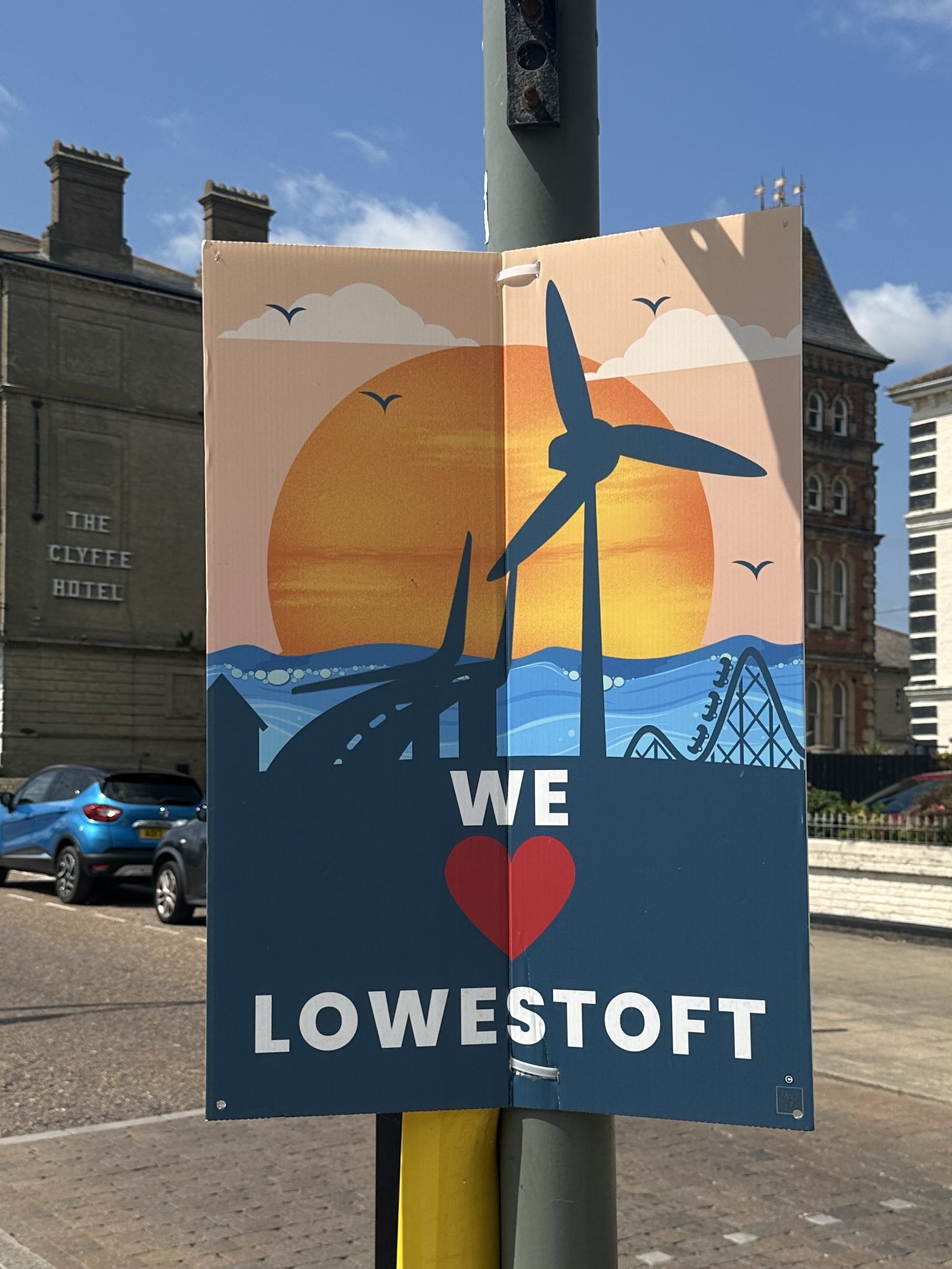
Recently, my local party tasked me with visiting the Suffolk coastal town of Lowestoft to assess its suitability for us to set up a table in the future to talk to local people about the utter mess our country is in and, crucially, what we can do about it. As it turned out, I found out that we could talk for hours to the local people about their town alone before we even start with the rest of the country.
I first visited Lowestoft when I was eleven years old and, despite coming back since then, it had been a while since I last visited the town. On the last occasion, it was to enjoy the south end of the town, which boasts two piers and a sizeable and beautiful beach. Lowestoft really is a town of two halves, split by Lake Lothing which runs through the town centre and separates the shopping area to the north from the beach and the piers to the south.
I decided to take a walk from the railway station which is located in the centre of the town – across the road from the Wetherspoon pub ‘The Joseph Conrad’ – up the High Street to see if there were any good spots for some willing communists to set up a table and talk with the locals. The first premises which stuck out was a large former Argos, which had closed in 2016 and relocated to the North Quay Retail Park, which is about a mile from the railway station.
Quite why the local council permitted the construction of a large retail park within a mile of an already struggling High Street is a question I’m not able to answer, but clearly it has sucked the life out of the town centre and for as long as it is there it will prevent the High Street from ever recovering. A planning application was submitted last year to transform the long-empty former Argos into a ‘adult gaming centre’. As it was, when I passed there was an eccentric man who was singing badly whilst playing the bongos. Whether that is an improvement on an Argos, or an ‘adult gaming centre’, I will leave to others to decide.

Lowestoft High Street is very much like many high streets in many provisional towns in terms of the shops that are still open – there’s a Ryman, a Marks & Spencer and a Wimpy, too. But what is striking is just how many empty premises there are. The former Westgate department store closed down in 2019 and has been empty ever since. It was approved for demolition in May last year, which highlights clearly that when large stores like Westgate close down, the council is largely powerless to do anything to repurpose either long-vacant buildings or the land on which they stand – it’s a prima facie example of how the private ownership of the means of production is a direct contributor to the empty stores which blight our town centres.

I decide to pop into the Waterstones and found myself wondering how any of these stores are still open – there was a tawdry collection of deeply depressing and uninformative books, including a David Baddiel book, which happened to be in the philosophy section. The High Street becomes bleaker as I cross Old Nelson Street and continue to walk north. The well-known high street names have disappeared and instead all I can see are a collection of empty premises, tanning shops, barber shops and bric-a-brac shops with wildly differing standards of salvaged tat available for purchase.

By the time I reach the end of my stroll up Lowestoft High Street at the Esso petrol station, I had lost count of the number of empty shops and ‘to let’ signs I had seen in a little over half a mile. It’s little wonder that the locals think that their town centre is dying – in an article written by Paul Embery for UnHerd in 2019, before Covid and the Government’s cack-handed response to the pandemic which plunged industries, including the hospitality industry, into total disarray, Dean, who moved to Lowestoft from south east London 34 years previously, said “The fishing industry has been destroyed. You used to be able to hop from boat to boat in the harbour. Now you’d drown. Factories have closed. The main shops have gone. All we’ve got left is takeaways and charity shops.”
Lowestoft is a case study in the decline of Britain’s industrial base as imperialism has off-shored industry and transformed our formerly industrial economy into a service-driven one. While the local economy was associated with fishing for decades, in truth the fishing industry in Lowestoft had been in decline since the 1930s and today there are no large trawlers operating from the dock. Only a handful of small boats fish in the local waters.

Apart from frozen food manufacturer Birds Eye, which employs 700 staff, the trend has been for the town’s major employers to leave Lowestoft. Sanyo closed their factory in 2009, Shell decided to close their base in the area over twenty years ago. The location of the town on the east coast of Suffolk makes it unattractive for would-be employers and attempts to pivot the local industry towards renewable energy have unsurprisingly foundered.
A walk along Lowestoft’s glorious seafront, with its sizeable beach and two piers, suggests that the only real hope for the town as things stand is to attract tourists. Clearly the number of tourists visiting has gone down – the imposing Harbour Inn, which greets visitors as they head north towards the beach, is closed all day on Mondays and Tuesdays, a reminder that the impulsive trip to the pub is beyond many people’s means these days.
Further along the seafront, work has begun on Jubilee Parade, a two-storey development of cafes and restaurants offering uninterrupted sea views for customers. The Government has given £4.3m towards the project, which was due to be completed by Spring of this year but is clearly behind schedule when I visited.

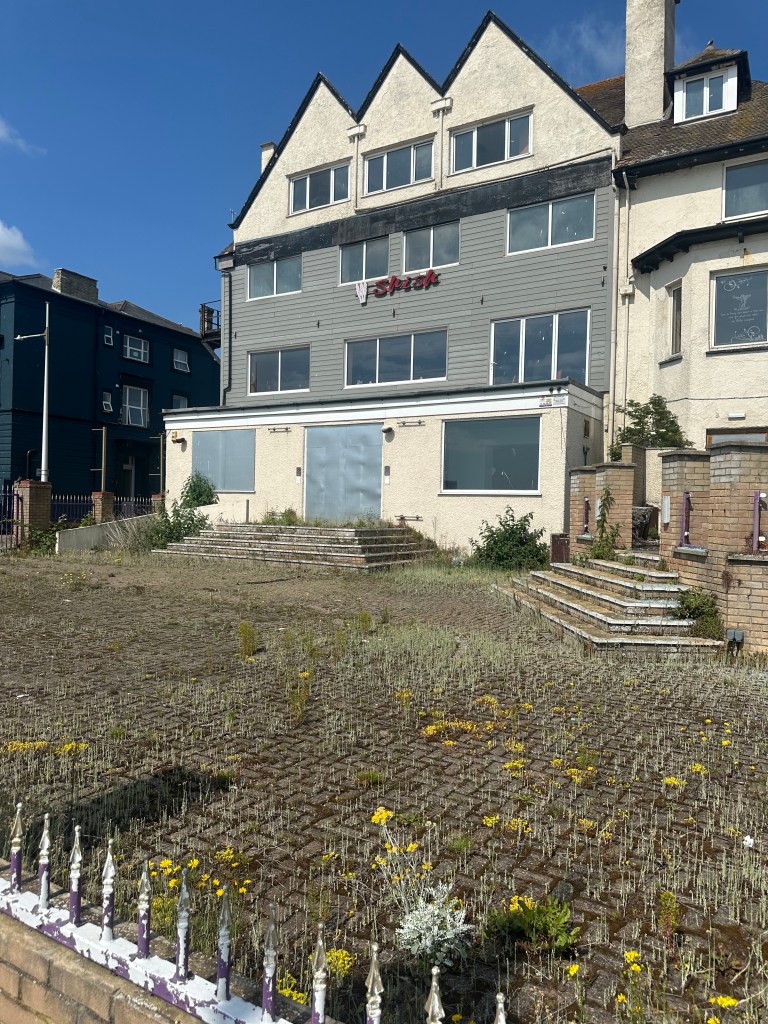
A large seafront restaurant called ‘Shish’ was boarded up and appeared to have been closed for some time. I took the opportunity to check the menu which was still pinned up at the door and, judging by the prices, it had closed years ago and served as a reminder of just how much the cost of living has impacted every aspect of life in Britain, including hospitality. A later Google search revealed that the restaurant had closed in 2019 and, despite a plan to reopen the restaurant in 2021, nothing had materialised and the building, now shuttered, blights what is a prime tourist spot.
Lowestoft clearly is a forgotten town – with its industry almost completely wiped out and its local commerce hanging on by its fingernails to survive, the signs of the town’s inexorable decline were everywhere I looked. It’s little wonder that, sat on benches by the Wetherspoon’s, people with little else to do congregate to drink strong beer and listen to Bob Marley on their mobile phones. It’s almost as if they have given up on the town that has given up on them.
Reform will surely have this parliamentary seat in their crosshairs at the next General Election – the constituency is currently held by Labour, but with a small 2,000 vote majority over the Tories, with Reform another 2,000 votes behind them. With Reform on the rise in opinion polls and with the voter turnout in Lowestoft at the last election of just 56%, Nigel Farage’s party will surely believe that they can bring together voters’ concerns about the decline of their town with Reform’s populist message.
For now, it is clear that the capitalist system, which has off-shored and closed down Lowestoft’s industries and overseen the decline of the town’s once bustling high street, has neither the interest nor the ability to restore towns like this to their former glories. Instead, their decline is managed and depressingly inevitable, with the local population left bewildered as to why any government of any stripe could treat a place as cruelly as the British government has treated Lowestoft.
We will return to this town in the near future. When we do, our message to the people of Lowestoft must be that we see as they do the decline of their town and that it is capitalism which has hollowed out their town, stripped its people of their dignity and deprived its children of their futures.
The only answer is not Labour, or Reform, or the Tories, but socialism.
 The Middle Aged Revolutionary
Leave a comment