

One of the first articles that I wanted to write when I first started this blog was in praise of Wetherspoon’s and, in the spirit of self-criticism, I should not have taken so long to actually write it and pledge to do better in future.
For the avoidance of doubt, I should preface my words by making clear that I am writing as a customer of Wetherspoon’s and nothing more. I like Wetherspoon’s pubs. They certainly aren’t the only pubs that I frequent, in fact I haven’t visited the one in my home town for years, despite my near constant statements to my wife that we should go there sometime soon. There’s a Greene King pub much nearer to me and I like the food there so that’s why, when I do pub, I tend to pub there. But I do like Wetherspoon’s pubs and will go in them whenever I can. Here is why.
There isn’t a town or city in the country that doesn’t have at least one Wetherspoon’s pub in it. Some have two, others have three. Some have even more than that. For me, one of the key benefits of visiting a Wetherspoon pub is that, regardless of where you are and your familiarity with your location, you can go into a Spoons and get a reasonably predictable experience every single time: The drinks will be fairly priced, food will be served and there’s a good chance that you’ll find a table (although I offer as one exception the Montagu Pike on Charing Cross Road in London, which is almost always in a state of utter bedlam and getting a bum on a seat in that pub is almost impossible – you may wish to add others from your own experiences). As someone who leans towards qualities like predictability and dependability in many things, from cars to comrades, Wetherspoon’s isn’t necessarily glitzy or flash, but it does what it says on the tin – so for me, it passes the ‘Ronseal’ test.
Are there better pubs around? Well everyone has different criteria for what makes a pub good – for some it’s the standard of the toilets, for others the selection of real ales, or snacks, or single malts available. Some think hot food is important, others what sort of non-alcoholic drinks are for sale. Whatever one’s preference, there will always be at least one pub which is preferential at any given time or any given place to a Wetherspoon’s. But shouldn’t a pub that serves reasonably-priced food and drink in a relatively convivial atmosphere be celebrated? To some, it seems, apparently not.
Wetherspoon’s does have a hardened group of sworn opponents. Some don’t like what they perceive as the corporate nature of the company, or the manner with which they treat their staff. Some don’t like the fact that working class and/or poor people frequent them, others just don’t like to general quality or the ambience. Some people don’t like Wetherspoon’s because of the man that heads the chain. There are a lot of myths perpetrated about Wetherspoon’s, the most common and debunked of which being the urban myth that they buy end of line products cheaply and pass those savings onto consumers, which is nonsense because Wetherspoon’s has the buying power of a major chain and has no need to scour breweries looking for reduced for quick sale booze. Wetherspoon’s negotiates prices based on the economies of scale (this is capitalism, after all), which means that they can bring greater pressure to bear on the breweries than the small landlord can.
So why do some people dislike Wetherspoon’s? Let’s look at and answer some of the main reasons in turn.
Sir Tim Martin
One of the chief reasons why people who dislike Wetherspoon’s dislike Wetherspoon’s is Sir Tim Martin, the founder and chairman of the group. Martin is the son of a former regional head of marketing at Guinness and his brother Gerry owned the pub chain Old Monk, so Martin is very experienced in the brewery and hospitality industries. But Martin’s qualifications to run his own pub chain isn’t why some people dislike the man. It’s his politics.
While Martin does not spent a great deal of his time bloviating about his positions on key topics, when he does his positions almost always run counter to those which prevail in the ‘left’. For instance, Martin backed Brexit and has been a staunch supporter of Brexit since the referendum in 2016. He also gave the Vote Leave campaign a £200,000 personal donation, and for these reasons he is enemy number one amongst the leftists which make up the bulk of the trade union and labour movement. With only the exceptions of RMT and ASLEF, every single trade union during the campaign period before the Brexit vote in 2016 took the same position – to remain in the European Union. This position was also adopted by the Labour Party, its members and cohorts, as well as other petty bourgeois leftist organisations and collectives. All this despite the European Union showing itself repeatedlyclearly to being an anti-worker, anti-socialist and imperialist trading bloc.
Martin certainly isn’t a socialist and equally certainly doesn’t oppose the European Union for the same reasons as actual socialists do, but as anyone who was an active participant in the fight to lead Britain out of the European Union in 2016 would have been aware: We were always likely to have uncomfortable bedfellows in our struggle, just as the Remain side were, but on that given topic at that particular time, we shared a common view and a shared goal, albeit for starkly differing reasons. It of course doesn’t mean for a moment that, when push comes to shove, Martin would not be an opponent of anyone who was actively and tangibly pursuing the transfer of the ownership of the means of production to the working class and nobody should pretend otherwise. But in the fight to leave the European Union, we were on the same side.
Martin was also a critic of the use of lockdowns during Covid, which closed down huge swathes of the economy, including hospitality. With hindsight, Martin’s critique that lockdowns were “over the top” were proven to be completely correct – lockdowns had a seismic effect on the economy and, while Martin may or may not have been aware at the time or since, were used as cover by the Government to pump billions of pounds into schemes including furlough, tax relief and rates relief to prop up an economic system that was already failing before the pandemic hit our shores. While the financial cost of the pandemic is quite straightforward to calculate, the human cost of the response may never be truly known – domestic violence levels went up, people were plunged into loneliness, financial troubles and yet further atomisation.
The trade union movement and the broader left took a deeply opportunistic position on Covid, with many self-proclaimed Marxists believing that it would lead to some magical reordering of the economy, when in fact it precipitated one of the biggest transfers of wealth from the poorest in society to the richest in history. The trade union and wider labour movement responded to the pandemic with uncritical compliance of lockdowns, even calling for harsher and longer ones, to near hysteria on mask wearing and the administration of vaccines, all of which have had their efficacies challenged, both at the time and in the post-pandemic analysis.
Again, Martin’s motives were, in all likelihood, self-serving – he couldn’t understand why his pubs and the business he leads were forced to close down on the basis of which section of industry it was a part of and, looking back, I and many others can’t understand, either.
In conclusion, one of the key reasons why Tim Martin’s critics are his critics is that, on these two key issues, Martin was correct, even if he may well be wrong on everything else.
‘They Lack Atmosphere’
Another popular criticism of Wetherspoon pubs is that they lack atmosphere. Like any pub, atmosphere is relative in the main to how busy that pub actually is, taking into account the size of the place. I particularly enjoy sitting in a quiet but cozy pub, preferably with an open fire, but of course not all pubs are like that. Wetherspoon pubs are generally notable for their vast size – their estate includes premises which were in their previous lives banks, post offices, cinemas and theatres. By their nature, they are strangely silent in their quieter periods but extremely noisy in their busier ones. But some Wetherspoon pubs have interiors which are stunning to look at: I think of the Crosse Keys in Leadenhall, London, or the Corn Exchange in Bury St Edmunds, or even Hamilton Hall, one of Britain’s busiest pubs, which is located just above Liverpool Street railway station.
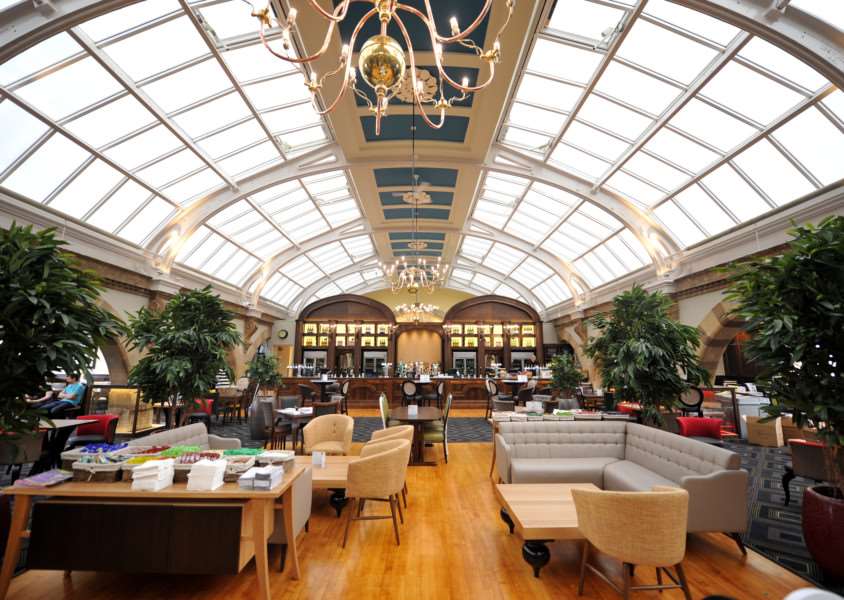
Yes, they can be distinctly quiet and often cavernous when footfall is low, especially in the case of the larger pubs, but as Alistair Hilton recently tweeted, footfall can be similarly low in other smaller pubs, especially when they insist on charging the better part of £7 for a pint of beer when the Wetherspoon’s up the road is charging less than half that price. The trade-off between atmosphere and value for money is much more straightforward when a pint of Stowford Press or Greene King IPA in a Wetherspoon’s is £2.
The Clientele
Another common reason for those who dislike Wetherspoon’s is the clientele. To those who are sworn opponents of the pub chain, the people who frequent them are, at least in part, essentially a reflection of the owner of the chain. By drinking in a Wetherspoon’s, these folk aren’t just drawn in by the reasonable prices, the unpretentious food or even the sometimes stunning decor. It’s because they endorse the views of Tim Martin. So to these opponents of Wetherspoon’s, and I’m thinking specifically of the loathsome faux-socialists (or fauxcialists) which make up a large chunk of the European Union fan club, Wetherspoon’s customer base are essentially Brexiteers on a budget.
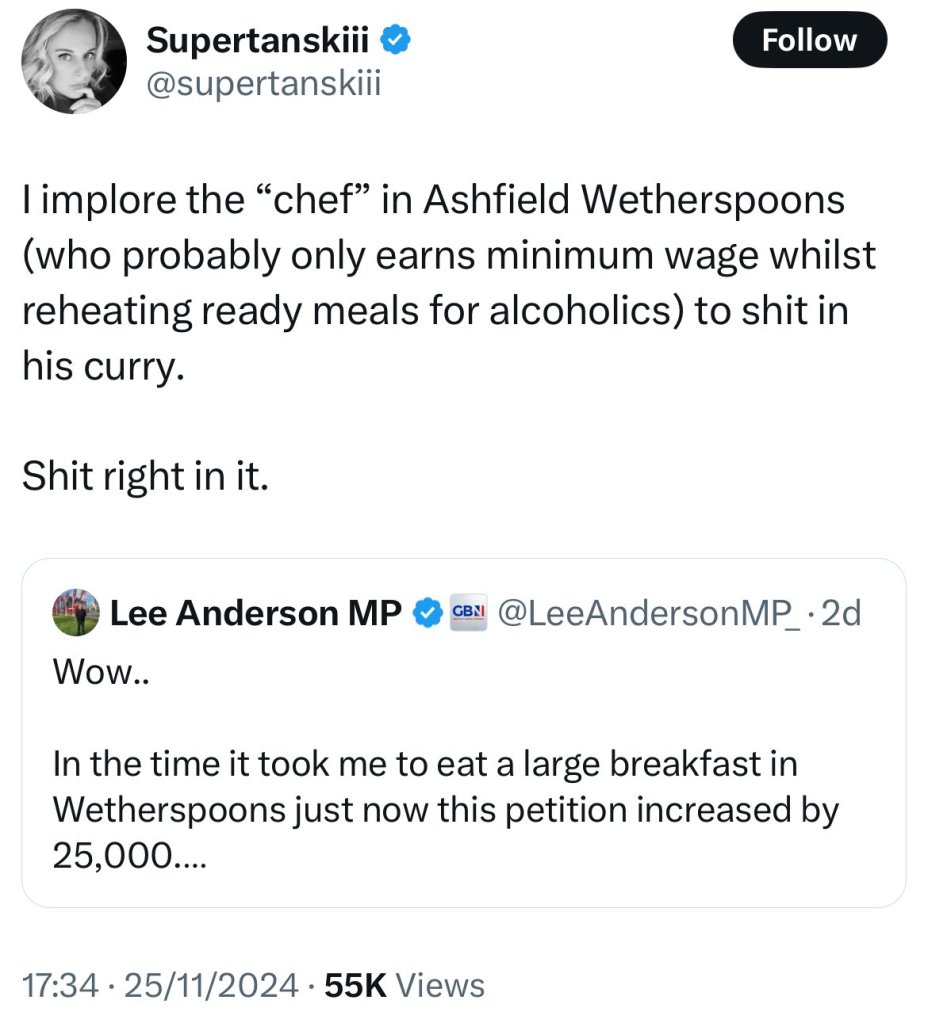
The sneering condescension, particularly from the petty bourgeois left, towards Wetherspoon’s and their customer base is rooted in the fact that they hate working class people but are too cowardly to say so explicitly. Their politics is based on the working class being some sort of charity case which they, as the clever and generous ones with all the bright ideas and the willingness to share them, can be endlessly benevolent to the working class as long as they stay in their box and shut up about grown-up topics of which they know nothing, like politics. When two-thirds of the working class voted for Brexit in 2016, these middle class do-gooders showed us all their true colours, unleashing their bile and hatred at the working class and everything that they stand for, including visiting a Wetherspoon’s every now and then.
They did the same again when the working class of the United States rejected the utter vapidity of Kamala Harris and returned Donald Trump to power for a second term as President. These people couldn’t have rejected Harris because she spent the better part of three months promising nothing to the electorate. No, they must have returned Trump to power because they are stupid racist bigots who really don’t know what is good for them. The petty bourgeois left have the same contempt for the working class of the USA as they do for the working class here.
Foul reactionary Will Hutton, part of this petty-bourgeois, EU-shilling, Fabian-esque grouping, proclaimed on X that he had started to boycott Wetherspoon’s “as a private, personal protest about its support for Brexit lies back in 2016”, seemingly unaware of the fact that nobody gave a toss about his ‘private, personal protest’, or that a private protest isn’t private if you’re taking to X to tell everyone about it but, more crucially, that him stating in a public forum that he would not set foot in a Wetherspoon’s pub ever again instantly made every Wetherspoon’s in the country a better pub to visit by dint of that alone. Those who are the most outspoken on Wetherspoon’s pubs and those who drink therein are often from the very class position and leftist political outlook who detest the working class the most.
The Treatment of the Staff
One key area where I have the most alignment with the critics of Wetherspoon’s is the manner with which their staff are treated. Wetherspoon’s used to be notorious for the amount of time and effort required to get served at a bar thirty yards long and staffed by two people. In the main, it’s better now, but there are still occasions when one can enter a Wetherspoon’s and find the place chronically understaffed, which of course only adds to the stresses and strains that the staff that actually are there experience.
Reviews of Wetherspoon’s as an employer on recruitment site Indeed vary wildly and depend predominantly on where the pub is located, so there seems to be a postcode lottery of sorts as to whether your local Wetherspoon’s is a decent place to work. What Indeed reveals is that the pay isn’t great, especially towards the lower end of the pay scale, with workers being paid just above minimum wage for being an ‘associate’. A common theme amongst those who reviewed their employer was that the hours were long, though of course this isn’t exclusive to Wetherspoon’s as an employer or the hospitality trade. Ask a care worker the hours that they have to do, for instance.
What is true however is that many people who work for Wetherspoon’s as ‘associates’ are young and will be gaining their first experiences in the world of work in a hectic, low-paid and often unrewarding role. Staff turnover in the pub industry generally is high, so the criticism that staff at Wetherspoon’s are treated ‘like numbers’ correlates directly with that high staff replacement rate. But whether Spoon’s is an outlier in the industry that it dominates is difficult to assert – Greene King, which owns over 3,000 pubs across the country, pay their kitchen and bar staff rates which are comparable to Wetherspoon’s almost to the penny. That doesn’t make Wetherspoon’s rates of pay acceptable in any way, but it reveals that the hospitality industry is not the place to be for reasonable hours, decent pay or rewarding work. Indeed, when lockdowns struck Europe in 2020 and pubs across the land were closed down, many people who worked in the industry left and didn’t return.
Being a customer of any store or pub chain isn’t in and of itself an endorsement of their working practices and Will Hutton-style boycotts are largely performative and achieve nothing. What is required is for established trade unions to get off their lazy, conceited backsides and actually recruit people who work in Wetherspoon’s and other employers in the hospitality industry and organise them to fight collectively for better wages and conditions. In this fight, I’m sure that Wetherspoon’s own customer base would be fully supportive.
Wetherspoon’s Have Squeezed Out the Independent Pub
There will be those who will have you believe that, in a time long gone by, pubs were independently owned by cheery landlords with big sideburns who served foaming flagons of ale to weary travellers while locals played dominoes in front of a roaring fire. Whilst an endearing and charming image, it is, certainly in the last thirty-odd years at least, complete bullshit.
Breweries have been in almost total control of pubs for decades and have had no compunction in closing them down to sell the land to developers when profits turn south. They have also had no apparent issue with their products being heavily discounted by supermarket chains to the point where ten cans of lager costs roughly the price of two or three pints of the same product in a pub. They have no compunction when it comes to pricing in their pubs – about eighteen months ago I paid £6.50 for a pint of Neck Oil in the Prince William Henry, a fine pub with two dartboards and more on Blackfriars Road in Southwark, London. The same pub closed down months ago and is reported to be in the crosshairs for a major new development of offices and an almshouse.
For those blaming the demise of the type of pub they think still exists but vanished long ago, there isn’t a Wetherspoon’s anywhere near the Prince William Henry. It closed down partly because it was too damned expensive and partly because clearly the brewery which owns the pub, Young’s, decided to cash in on a prime piece of real estate near two major transport hubs (both Blackfriars and Waterloo are within walking distance), close the place down for good and flog the land on which it stands to property developers. Pubs are closing down for good at an alarming rate, but to blame Wetherspoon’s for that is to be wilfully ignorant of the changing landscape – younger people are drinking less than the generations before them, breweries couldn’t care less about the survival of their pubs and yet, on most nights, Wetherspoon’s will still be busy, serving pints from as little as £2.
In Praise of Wetherspoon’s
I totally reject the snobbiness of those who hate Wetherspoon’s and those who frequent them for what it is – petty bourgeois arrogance and revulsion towards working class people. I also reject the idea that Wetherspoon’s swept the independent pub from communities across the country – that accusation should be levelled squarely at the breweries. Breweries like Marston Carlsberg, who have just announced that they would be withdrawing permanently eleven beers from sale, including well-known real ales like Bombardier and Ringwood’s Old Thumper.
But Wetherspoon’s are what they are: Unpretentious, simple and pretty cheap. And, for as long as places like Wetherspoon’s exist and for as long as they serve reasonably-priced drinks and food to people, I’ll continue to be in fulsome praise of them.


 The Middle Aged Revolutionary
Leave a comment