
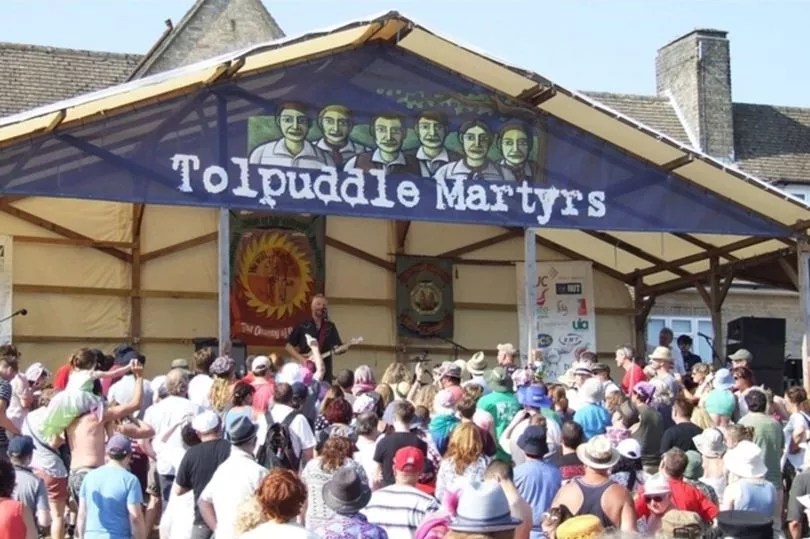
In my previous life as a trade unionist, I visited the Tolpuddle Martyrs’ Festival on several occasions. For readers who aren’t aware of what this festival is all about, it commemorates the struggles of the Tolpuddle Martyrs. Six farm labourers, including George Loveless, were arrested in 1834 for swearing an (illegal) oath of secrecy under a sycamore tree in the village of Tolpuddle in Dorset. By the way, the tree is still there.
They formed a ‘friendly society’ (a rudimentary trade union) by swearing this oath to protest against their pay of just six shillings a week for their labour. The landowner and local magistrate, James Frampton, found out about his workers’ conspiracy against him. He sought to stamp it out. George Loveless and his comrades were arrested and charged under the obscure and largely unused Unlawful Oaths Act 1797. They were found guilty and sentenced to transportation to Australia. When he was sentenced, Loveless wrote a hymn called ‘The Gathering of the Unions’, which included the line “We will, we will, will be free!” – a line that is repeated often by speakers at Tolpuddle Festivals to this day. The Martyrs became heroes in England – a petition to campaign for their release garnered 800,000 signatures, while supporters organised a march which was one of the most successful in history. Following this concerted public action, all of the Martyrs were granted a pardon in 1836 and returned to England.
The story of the suffering of the Martyrs is woven into the very fabric of the British trade union movement. Every year, the Martyrs’ Festival sees thousands of people from the four corners of the land come to a tiny village in Dorset, with no shops and only one pub, to remember the sacrifice that these brave men made in the name of solidarity. Unfortunately, after the march has taken place through the main road in Tolpuddle (called Main Road, funnily enough) and everyone has enjoyed the sunshine, the NASUWT brass band and a few pints at the Martyrs’ Inn, the assembled throng returns to the field which plays host to the Festival and, on alternate years, have their ears assaulted by the dirge-pedlar-in-chief that is Mr Stephen William Bragg, better known to those who love and hate him as Billy Bragg.
Those that know me at all will also know that I loathe Billy Bragg. I loathe his ‘t-dropping’ faux-Cockney singing style, his blind faith in trade unionism, his politics and, above all, his music. From a purely personal point of view, I find it and him utterly intolerable and it frankly baffles me that anyone could find his music stirring, moving or entertaining. The trade union and wider labour movement in this country has always held certain very shady individuals in undeservingly high regard. These include repugnant turncoats like John McDonnell. They also include repellent faux-socialist grifters like Yanis Varoufakis, to name just two. Billy Bragg is part of this elite group of individuals who have attained similar blind and underserved reverence.
I remember a few years ago travelling in a cab from the Festival to the cottage I’d rented in nearby Dewlish. The area’s narrow roads with no pavements made it prudent to use cabs both to and from the Festival. While it wasn’t that far from Tolpuddle to where I was staying, the cab would come from Dorchester and so charged higher fares to reflect that fact. I got to chatting with the cabbie. Amid the talk about the local police coming down heavily on drink-drivers in the area over the weekend, I was asked if Billy Bragg was playing. I confirmed that he was, to which the cabbie replied “Yeah I used to like him back in the day, but he sold out years ago, didn’t he?”, to which I wholly agreed and expressed my own views on the man and his music. It made me think that if a cabbie in Dorset thought that he was a sell-out, I certainly couldn’t be an outlier in my opinions about him. It’s my impression that, like the frauds McDonnell and Varoufakis, the trade union and wider labour movements only continue to give Bragg a platform because they don’t want to appear cheeky or non-compliant.
When asked my own reasons for disliking the official bard of the trade union movement, my first line in response is often “How long have you got?”, so wide and varied are my reasons for rejecting Bragg and almost everything he stands for and creates. But in the spirit of full openness and transparency, I’ll detail some reasons in the following paragraphs.
As I have already stated, I don’t like his music. At all. Besides the fact that I am usually not enamoured with politically-based music, Bragg’s fake earthy working class t-dropping style often sets my teeth on edge. Bragg was born in Barking, about ten miles from where I was born. My mother was from Hackney and my father was from Rainham. I drop my t’s occasionally when I speak, but never when I sing (as anyone who has heard my rendition of Elvis Presley’s ‘If I Can Dream’ will testify). In fact, I know very few people from the east end of London and Essex who drop their t’s when they sing, even if they do so constantly when they talk, which makes me believe that if it isn’t effected by Bragg, then it certainly sounds like it is. Whether his rotten songs would sound better if he was to sing like the rest of us is doubtful, but his style puts the cherry on top of the Belgian shit-bun that is his music.
Which brings me onto the second of my many objections to Bragg, which is his self-created working class hero act which he seems to try to play. Bragg was working class, a long time ago, and perhaps he was a hard-working tradesman with only a guitar and a head full dreams at one point in the past, but he’s most definitely not now. His conduct, which resembles that of a well-remunerated trade union bureaucrat, shows clearly that he is a very rich man – made wealthy from not only the sales of his music, but also in part from the sale of his humble dwelling in Blandford Forum, a little village just east of Bridport in Dorset, which he allegedly sold to a Goldman Sachs banker for over £3m. This after slagging bankers off, quite rightly, for their part in the financial collapse of 2008 (although it wasn’t entirely the fault of the bankers rather than the deep faults which exist within imperialism). He even wrote a song, called The Jolly Banker, where he sang “When money you’re needing and mouths you are feeding I’m a jolly banker, jolly banker am I.”

Mr Bragg has anlso shown himself to be deeply censorious when it comes to free speech and expression. He not only fully supported the censoring of books by noted children’s author Ronald Dahl under the threadbare argument that free speech did not extend to ‘abuse’ (in this context the use of terms like ‘fat’ and ‘crazy’ were considered to be abusive), but in 2021 he effectively censored himself when he altered the lyrics to his song ‘Sexuality’ from:
“And just because you’re gay I won’t turn you away/If you stick around I’m sure that we can find some common-ground.” to:
“And just because you’re they I won’t turn you away/If you stick around I’m sure that we can find the right pronoun.” in a totally vapid and empty display of virtue-signalling, fawning to the middle class liberal leftists that make up sizeable chunk of his modest fan base. Further to this, in a Twitter exchange, Jean Hatchet, a feminist and writer, challenged Bragg on his decision to change the lyrics to his own song. Jean tweeted:
“Being same-sex attracted is not the same as a gender identity. You knew the difference between sexuality and gender identity when you wrote the song presumably? What changed?”, to which Bragg responded:
“Times changed. Anyone born since the song was released would wonder why it’s a big deal to find common ground with a gay man. The front line now is trans rights.”
It could be argued that since the legalisation of gay marriage in 2014, gay rights have clearly taken a back seat in favour of trans rights, not only by the likes of Bragg, but by charities like Stonewall and huge swathes of the labour movement. It could be also argued (and it certainly is by many prominent lesbians and gender-critical women on social media) that Bragg has a noticeably more hostile tone when interacting with Twitter users who are women. Some have called him an outright misogynist. Much like the modern trade union movement, there is nothing that Bragg won’t jettison in favour of the ‘current thing’, including trans rights or defending the right for women to be ruthlessly exploited as prostitutes and/or strippers. Often, this exploitation of women feeds the drug addictions that they developed, primarily through being forced into becoming prostitutes and/or strippers in the first place. Yet Bragg, who seems to be attracted to contemporary ‘progressive’ causes in the same way that a moth is attracted to a flame, does this under the guise that they are ‘sex workers’ and that ‘sex work’ is legitimate work.
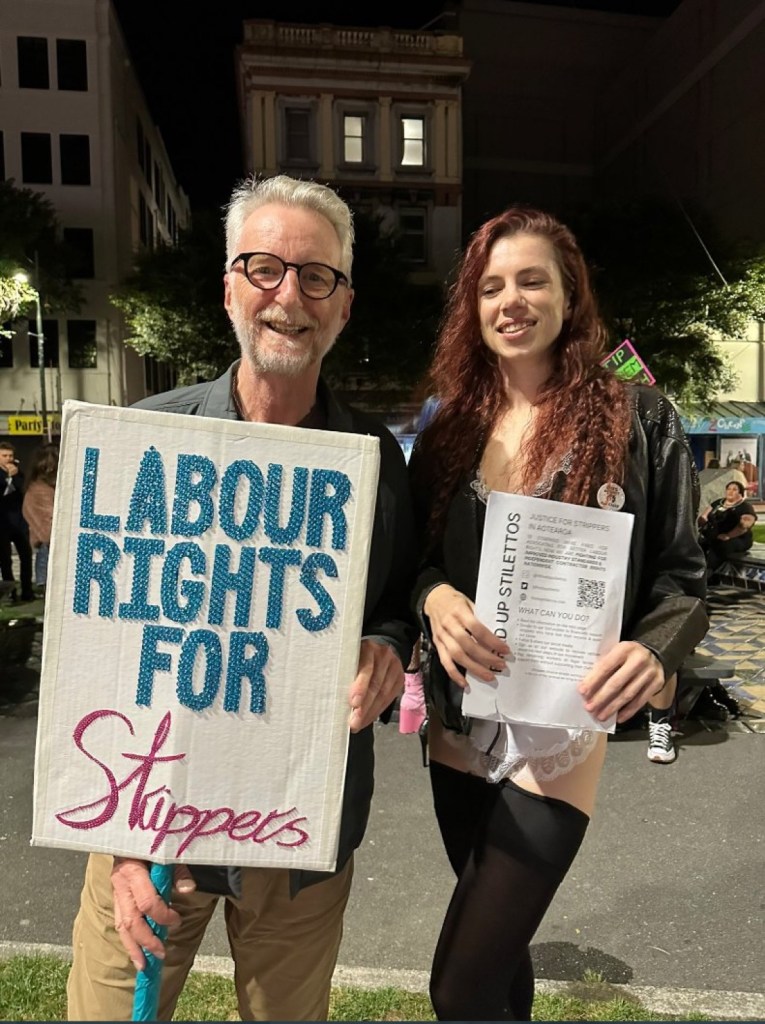
Whether it is by altering the lyrics to his own songs to suit the current thing, or supporting the hyper-exploitation of women’s bodies, or even the alleged sale of a house to a banker, Bragg has shown through the evidence of his own actions that this Barking-born working class lad has for a long time become as detached from the working class and their struggles as it is possible to get. To hear him speak or to read his social media output is to hear or read exactly the same liberal-left twaddle that I would expect from any trade union General Secretary in 2024. He, like those General Secretaries, serves the ruling class by diverting trade unionists and labourist votes straight into voting for the Labour Party (or the Greens, as he has done in the past). Bragg, his politics and his music should all be totally rejected.
His popularity amongst sections of the labour aristocracy and trade union bureaucracy is precisely because he is like them – he speaks in their language, he makes the same empty demands that they make and diverts the disaffected and downtrodden straight into the dead-end of Labourism. Bragg is a man who has made his vast fortune by selling himself as the bard of the working class, but he is in fact nothing more than the bard of the trade union bureaucracy.


 The Middle Aged Revolutionary
Leave a comment