
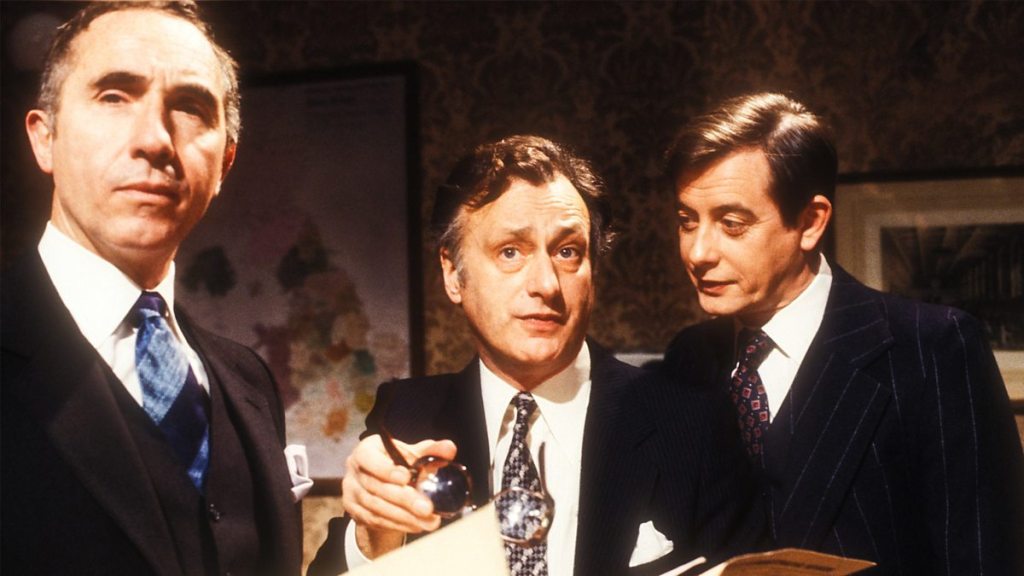
There are some things which age very well over time. Like a fine wine, a dry-aged steak or a particularly stinky Stilton, both Yes Minister and Yes, Prime Minister have not only withstood the test of time in terms of their relevance and their contemporary humour but have, in my view, become essential viewing for anybody who enjoys intelligent, well-paced and searingly accurate satire. In fact it could be said that as a television programme, it is far more informative and insightful than anything made today, comedy or not.
Written by Jonathan Lynn and Anthony Jay, Paul Eddington plays the Right Honourable Jim Hacker, Member of Parliament for the fictitious Birmingham East constituency. Eddington had been an actor for most of his adult life, but only came to public prominence in his 40s when he appeared as the somewhat downtrodden Jerry Leadbetter, husband of the irrepressible Margo, in the hit 1970s sitcom The Good Life. The identity of the party that Hacker represents is never revealed but, as it turns out, the party is actually irrelevant, because the central pillar of both these comedy series is the persistent struggle between the people who think that they run the country (the Government) and the people who really do (the Civil Service. Hacker’s party, signified only by a white rosette as he stands on the balcony of the local town hall as MP, wins the General Election and so forms a Government.
Hacker, who was a Shadow Minister prior to the election, becomes Minister for Administrative Affairs. Viewers of the more recent BBC political comedy The Thick of It would have noticed the similarity between the fictitious Department of Social Affairs which featured in that show and Hacker’s department: Both entirely plausible-sounding divisions of Government which work hard at doing nothing. Hacker, who is something of an idealist, is keen from day one to make sweeping changes to the way that the Ministry and the Government is run, yet finds himself having to reconcile with the institutionalised resistance of the Civil Service, most ably personified in his Permanent Secretary, Sir Humphrey Appleby.
Sir Humphrey, played by Nigel Hawthorne, portrays himself as an experienced, knowledgable and extremely self-assured Civil Servant who, while prone to the occasional gaffe, both in the present and in his past, fundamentally acts always to serve the interests of the Civil Service itself and its vice-like grip on the real levers of power, whilst at the same time seeking to give his Minister the assurance that he really does work for him. His skills in obfuscation and diversion are unparalleled and reveal him to be a consummate bourgeois state operator. His aim is always to maintain the balance between satisfying the wishes of his Minister for change, while at the same time maintaining the status quo.
Hacker’s Principle Private Secretary is Bernard Woolley, played by Derek Fowlds. Junior in rank to Sir Humphrey, Bernard finds himself caught between two stools: One in serving his Minister, who he seems to quite like and wants to serve honestly, and the other in serving his boss, who is not in the least bit afraid to bring pressure to bear on him to do what is in the best interests of the Civil Service, not necessarily Jim Hacker or the Government. Bernard is generally sympathetic to Hacker’s policy changes, often because he sees no glaringly-obvious reason for them not to be put in place, until Sir Humphrey, in his own inimitable way, explains to Bernard exactly why Hacker’s schemes can’t and won’t be allowed to work. Woolley also ably assists his Minister in correcting all his mixed metaphors, often to Hacker’s annoyance.
Yes Minister, which ran for three seasons, tells the story of Hacker’s elevation to the Cabinet, his struggles against the Civil Service machine as they frustrate and hamper him in his attempts to set own his own stall. This begins in the very first episode, when Civil Servants put Hacker’s political advisor, Frank Weisel (which everybody in the Civil Service staff pronounces as ‘weasel’, much to Weisel’s chagrin) in a waiting room for hours until he is called to the Minister’s office before proposing that he could have an office of his own, in Walthamstow, about nine miles from Westminster. Interestingly, there is not one scene in the entire series which is set in the Palaces of Westminster – the aim of the programme is to demonstrate that actual Goverment takes place in the departmental buildings dotted around Whitehall, often behind closed doors and by people with immutable pre-conceived ideas about what things should be done and how.
That isn’t to say that Sir Humphrey always gets his own way – often episodes conclude with both Hacker and Appleby at least winning a version of the win that they set out to get, even if it was not the goal that originally intended to achieve. Often this outcome arrives by some deft chicanery on the part of both men, with Hacker growing more and more aware of Sir Humphrey’s motivations and methods as the series develops.
The final episode of Yes Minister, the Christmas special ‘Party Games’, Hacker finds himself embroiled in a race to the Premiership when the Prime Minister unexpectedly announces his resignation. The Civil Service, most ably led by Sir Humphrey Appleby, works to make sure that, at least in their perception, the ‘right’ man lands the job. Hacker, who is initially reluctant to enter the fray but exercised by a Brussels proposal to demand that the British sausage is renamed ‘the emulsified high fat offal tube’ because if its famously low meat content, is encouraged by the Civil Service, as well as the unfortunate proclivities of his opponents, to throw his hat into the ring. His appointment as Prime Minister gave birth to a sequel, Yes, Prime Minister, which ran for two series.
Both Yes Minister and Yes, Prime Minister stand as one of, if not the the best, political satirical British comedy series ever created, though many will believe that The Thick of It deserves to be considered in that small and privileged group. In simple terms, it is fantastic comedy, whether it be Eddington’s face transforming from unbridled joy to deep and completely confected sorrow when he hears that his predecessor has died with his memoirs, which were predicted to be critical of Hacker, unfinished, or Sir Humphrey’s brutally honest appraisal of Britain’s place in the world and the chasm which exists between the perception of British strength and the reality of its weakness.
Both series also revealed certain uncomfortable truths about Britain in the late-twentieth century: Like a Church of England hardliner was someone who actually believed in God, or Britain’s nuclear deterrent was designed to make Britons feel safe rather than Soviets feel threatened, and Britain’s closer integration with Europe was specifically designed to sow division and dispute amongst our ‘allies’ on the continent.
Sadly, Yes, Prime Minister came to an abrupt end as a series owing to creative differences between Paul Eddington, Nigel Hawthorne and the BBC. The BBC wanted to transform the series into a pre-recorded show without a live audience, however Eddington and Hawthorne wanted the programme to remain as it had always been, recorded in a studio with a live audience part of the proceedings. After a total of five series, Yes Minister and Yes, Prime Minister had come to a close.
If you haven’t seen it, then you really should. I’ll close with my favourite quote from the show, which featured in the first episode of Yes, Prime Minister –
Hacker: “I know exactly who reads the papers. The Daily Mirror is read by people who think they run the country. The Guardian is read by people who think they ought to run the country. The Times is read by people who really do run the country. The Daily Mail is read by the wives of people who run the country. The Financial Times is read by people who own the country. The Morning Star is read by people who think the country should be run by another country. The Daily Telegraph is read people who people who think it is.”
Appleby: “What about the people who read The Sun?”
Bernard: “The Sun readers don’t care who runs the country, as long as she’s got big tits.”
Yes Minister and Yes, Prime Minister are available to watch on ITV Hub.
 The Middle Aged Revolutionary
Leave a comment