

On a dreary, rainy and generally miserable May late evening in London, Prime Minister Rishi Sunak addressed the nation to inform them that they would be forced to endure a General Election on 4th July. Not only would they be forced to endure a General Election, arguably worse still they will be forced to endure a six week election campaign, with everything that makes such occasions test to their limit the gag reflex of the electorate.
Sunak has timed this election to take place just before the summer holidays, arguably giving him the best chance to give the portion of the electorate that actually will bother to get out and vote the opportunity to do so, whilst banking on Britain’s ever-reliable weather to bestow upon him favourable conditions for voters to trudge to their polling station, ballot card (and ID) in hand to cast their vote for their elected oppressors.
Sunak is not striking while the iron is hot, rather he is striking while the iron isn’t stone cold. He would have seen the figures on the UK’s Gross Domestic Product (GDP), which grew at a mind-boggling 0.4% in the month of March, exceeding expectations by a full 0.3%. He would also have seen the rises in interest rates that we have seen for the last two years levelling out at a still fairly hefty 5.25% and the housing asset bubble continuing to inflate, which in this stage of British capitalism, is vital for any governing party because they know that sizeable sections of the electorate will use the health of the housing market as their personal barometer to gauge the health of the rest of the economy.
Sunak would also have seen that inflation is down to 2.3%, a figure that looks comparatively normal when compared to the rampant rates that we have endured over the last two years. the Retail Prices Index leapt from 1.5% in April 2021 to 9.0% in April 2022. While the lowering of the rate of inflation would be welcomed by most of the working class, the fact remains that the rate of price increases has gone down, not the prices themselves. All the essentials that people need from their local supermarket are still at least 20% more expensive than they were three years ago and there is precisely no possibility of these prices reducing any time soon. This while only a relatively small section of the working class, namely the unionised section, have won pay rises that have kept up with inflation or have come even close to it.
The Conservatives will also have been encouraged to a degree by Labour’s rather uninspiring local election results. While the Tories suffered a pretty miserable night on 2nd May, it was parties like the Greens which made a more sizeable impression than the Labour party. Labour are not helped by having a block of wood as a leader – Sir Keir Starmer’s approval rating is just 36% according to YouGov and the cabal of scumbags which make up his shadow cabinet have not landed anything like the blows that could knock down a Conservative Government so out on its feet, that a light breeze could floor it.
Sunak will be going to the polls at a time of year when the weather is least crap and the contemporary economic conditions of the country are at their least crap, against an opposition that is quite crap. This is clearly a damage limitation exercise – not an election that the Government is calling to win, but calling it to not lose too badly.
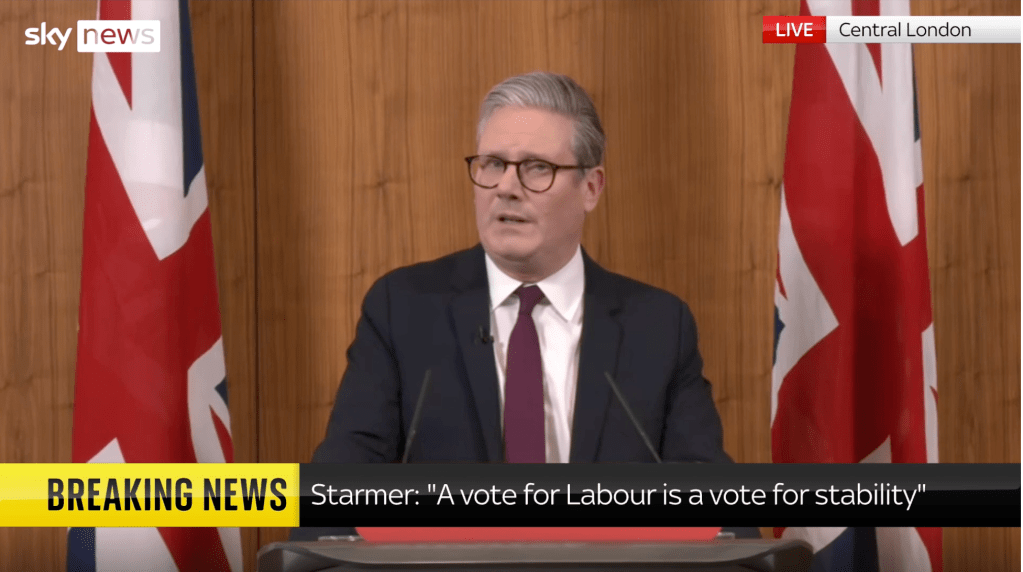
But what of His Majesty’s Opposition? Sir Keir Starmer made his own speech in what appeared to be a wardrobe, festooned with Union Flags, to proclaim that this was a General Election that the “country needs and has been waiting for”, a claim which I would dispute given the paucity of tangible options on offer. Starmer went on to claim that the Labour party had changed and “returned it once more to the service of working people”, a claim that ignores the party’s history, which is that it was founded as a party of imperialism and to act as a roadblock to socialism. Starmer then went on to bloviate about a Labour Government would restore stability and “unlock the potential of every community”, words that will ring particularly hollow in towns like Boston in Lincolnshire or Lowestoft in Suffolk, or even Clacton in Essex, which have been left to rot by both Labour and Tory Governments going back decades.
Starmer, whose speech lasted all of five minutes, spoke in empty terms about rebuilding the country, regaining trust and ending chaos. Yet Starmer backed the chaos that the Conservatives caused in their ‘response’ to Covid – Labour called for longer and more harsh lockdowns, Labour MPs were part of the ludicrous ‘Zero Covid’ campaign that came and went in a blink of an eye and has been remembered by virtually nobody, and Labour was all-in on the use of experimental drugs being trialled on the general public in response to Civid. Labour has fully backed the British Government’s and the wider imperialist bloc’s actions in its response to the Special Military Operation in Ukraine, despite the ensuing chaos that has disrupted supply chains and energy resourcing and has helped fuel inflation.
Starmer’s speech was as wholly unconvincing as Sunak’s rain-soaked oratory and it is clear that, whatever talents that these two protagonists do possess, public oratory isn’t among them. It was also clear that, whatever their public speaking skills, neither of them have anything to offer voters. British capitalism is in a deep rut – its industrial base is all but gone, it relies on financial services to survive and the rate of investment from the private sector is practically zero. Neither party has any answers to the problems which have beset the British imperialist system, other than to do more of the same – support for Banderists in Ukraine, support for the genocide taking place in Gaza, the continued looting of the NHS by robber barons and workers unable to stand and fight effectively against their employers by anti-trade union legislation.
But what of the other options? Surely in a pluralist political system such as ours, there must be other viable parties we could vote for?
The Green Party could have a role to play in the election. It appears to have become a refuge for the remaining late-stage Corbynistas looking for somewhere to land and they have taken the Green Party’s eco-imperialism to be some sort of reheated Corbynism. The rise in the popularity of the party may well peel off some petty bourgeois liberal voters from Labour and Conservatives and, while it is unlikely that they will add to their current Member of Parliament tally of one at the next election, they will in all likelihood take votes from both major parties.
Meanwhile, the LibDems have been conspicuously quiet for a considerable time, which could at least be partially explained by Sir Ed Davey, the leader of the party, being implicated in the postmaster scandal which was blown wide open by the ITV drama series Mr Bates vs The Post Office. Fifteen years ago the Liberal Democrats pitched themselves as to the left of the Labour party, passing progressive resolutions at their annual conferences, however voters will not have forgotten what happened when they went into coalition with David Cameron’s Conservatives in 2010. It is still conceivable that they would be open to a coalition with Labour if they win a majority but not an outright majority.
One important party to consider is the Scottish Nationalists, who occupy the 54 seats that Labour once occupied in Scotland up until 2015. It was the loss of these seats that rendered any future majority Labour Government virtually impossible, given the number of seats up for grabs and the relatively few seats that actually swing between Labour and the Conservatives in the rest of Britain. They have had a tumultuous period, which started back in March 2023 when Nicola Sturgeon resigned amid controversy over the party’s finances and serious policy missteps. Yumza Yousaf, who won the leadership, resigned a little over a year later following his decision to dissolve the coalition that the SNP had with the Scottish Greens (who are like the English Greens, only much worse) in the Scottish Parliament.
The SNP in reality have little to no interest in actual Scottish independence. At best, they posture from time to time to call for a referendum, which they use as leverage to gain concessions from Westminster. Without the leverage, there are no concessions. But their reputation has taken a severe battering over the last eighteen months, which may lead them to lose some seats, but it is more likely to lose them seats to Alex Salmond’s Alba party than to Labour, given Labour’s toxic reputation in Scotland which has persisted since the last independence referendum in 2014.
For both the Tories and Labour, their chances of outright majorities are under threat from other smaller parties: In the case of the Tories, it will be Reform UK which will pose their biggest threat to keeping their voter base intact, while for Labour it will be the Greens and the Workers Party of Britain.
Reform UK, the descendent of the old Brexit Party, will promise to conservative voters some real conservatism in a world where the actual Conservatives are really liberals. They are also unabashedly opposed to the Conservatives and willing to stand candidates in direct opposition to them on a populist policy platform. The party did not achieve any success in the local council elections, but they will be confident that they can land real blows on the Conservative Party on July 4th.
With regard to the Workers Party of Britain, it is debatable whether their solitary MP, George Galloway, will retain the Rochdale seat he won in February. But the party has been bullish in its claims that it will stand candidates in every constituency in the country. The fine print, however, is that candidates will have to stump up the £500 deposit for standing themselves, which will mean that there will be many working class potential candidates who will not be able to stand because they won’t be able to afford it. The party has also suffered an embarrassment when Monty Panesar, the former England cricketer, announced that he would be standing as an MP in the Ealing Southall seat, only to withdraw a week later claiming that he needed to improve his political understanding.
However, Galloway’s message on Palestine resonated in Rochdale and, with the slaughter in Gaza continuing, it may land again in July. The Workers Party’s targets will undoubtedly be in cities like London, Manchester and Birmingham, where there are communities more sympathetic to the Palestine cause. While the party claims to be socialist, it is in fact a social democratic party, with all the limitations that come with social democracy. However they will feel confident that they will take seats from Labour, or at least be a king-maker in swing seats, so it will be interesting to see how their campaign pans out.
Finally, I wanted to look at the trade union movement leadership, who surely will spend the next six weeks humiliating themselves and their loved ones by calling for their members to vote for the block of wood in his cupboard that is Sir Keir Starmer. It will be quite an unedifying spectacle for a movement whose leadership is almost completely disconnected from their own membership base to nail the point down completely by trying to persuade that same membership to vote for a man and a party promising nothing that would distinguish them from the Conservative party. They will no doubt evoke memories of the 1945-1951 period, when the Labour Government nationalised 20% of the economy, founded the NHS and introduced the welfare state, whilst at the same time omitting to mention why they did it or how it was paid for.
There will be ‘firebrands’ like Sharon Graham, one of the trade union movement’s most false and disappointing dawns, preaching at every given opportunity how we must all vote Labour, but that will not mean that Unite (who bankroll the party to the tune of millions of pounds every year) won’t hold Sir Keir’s feet to the fire if Labour do not stand up for the workers. This is despite the Labour party already rowing back on its pledges to ‘working people’ in order to placate business, which is of course Labour’s target audience. There will be people like Mick Lynch, who showered himself in glory during RMT strikes in late 2022 as his members were fighting for a pay rise that they hadn’t seen in three years then showered himself in the manure of backing the Labour party, a party that even his own members will not affiliate their union to. No doubt Lynch will spend the next six weeks backing Labour and cementing his well-deserved reputation as an archetypal trade union bureaucrat.
And that is before the other servile Labour-backing unions, from the Union of Shop, Distributive and Allied Workers (USDAW), to Associated Society of Locomotive Engineers and Firemen (ASLEF, whose reactionary General Secretary Mick Whelan backed Labour within seconds of Starmer’s speech), to Unison, to the Communication Workers Union (CWU) the Transport Salaried Staffs Association (TSSA) and others all come out to give their unequivocal support to the Labour party and their programme for changing nothing. It will be horrifying, depressing and infuriating all the same time to see.
British capitalism has a profitability problem, which can only be ‘solved’ by the ruling class by forcing the working class to work longer for less money. There is only one party which is fully equipped to take on this task – and that is the Labour party.
Only the Labour party is able to lead any attack on the hard-won terms of conditions of workers, because it has more or less the entire trade union leadership firmly in its back pocket. From Graham to Lynch to Lillis to Whelan to Ward, every leader of every Labour-affiliated trade union will roll over to get their belly tickled while the party destroys what precious little benefits that workers have won for themselves. It is a deeply worrying prospect that Labour, most likely as part of a LibLab coalition, would win a majority of sorts to push through their ‘reforms’.
The best that we can hope for is that, in this latest exercise in bourgeois democracy, whichever party wins cannot win the mandate that they need to lead a strong Government. There are enough potential potholes in the road for both the Conservatives and Labour to make this a genuine possibility. It is from this that the working class will be able to see again the evidence of their own eyes – that British ‘democracy’ is, at least for them, only participatory – they are invited to take part every few years and then their voices are ignored. In order to win a world where full employment, human flourishment and peace can be a reality, the working class must smash once and for all the grip on power that the ruling class has.
As Lenin said about bourgeois democracy:
“And so in capitalist society we have a democracy that is curtailed, wretched, false, a democracy only for the rich, for the minority. The dictatorship of the proletariat, the period of transition to communism, will for the first time create democracy for the people, for the majority, along with the necessary suppression of the exploiters, of the minority.”
 The Middle Aged Revolutionary
Leave a comment